
Factors influencing On-Farm Nitrogen Use Efficiency
The Fertilizer Association of Ireland highlights several factors influencing on-farm nitrogen (N) use efficiency.
These factors can be broadly categorized into management practices, soil and environmental conditions, and the specific characteristics of the farm enterprise.
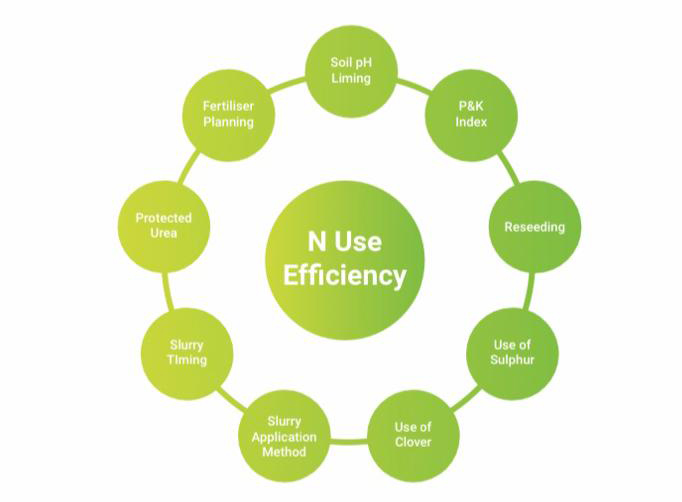
Soil pH
- Optimum soil pH is 6.3 for grassland & clover pH 6.5 to 7.0
- Maintaining soils at optimum soil pH can releases up to 70kg N/ha/year
- Regular Soil testing and Lime application will optimise NUE
Target Soil P & K Index 3
- Build soils to Index 3 for P and K
- This will improve N uptake and crop yield for improved NUE
Sulphur (S) promotes N efficiency and conversion to protein
- Apply S in grazing at a rate of 1 unit S to every 10-12 units nitrogen applied.
- Silage ground requires 16 units S/ac for each cut.
Protected Urea
- Reduce N losses as nitrous oxide (GHG) or ammonia. Reducing N losses improves NUE by switching Urea and CAN to Protected Urea.
- At present 18 product options are available from six fertiliser manufacturers.
- Find out more here »
More about Nitro-Guard Protected Urea
Clover Use
- Animal
Increased dry matter intake + 1.5 kg DM/cow/da
Increased milk solids production + 30 kg MS/cow/year - Sward
Increased dry matter production – + 800 kg DM/ha
Potential to reduce nitrogen fertiliser with white clover contents >25%
Slurry application method
- Use LESS technology to improve NUE by reducing N losses
- The N fertiliser replacement value of slurry increases by 50% when using LESS methods compared to splash-plate
- Spring application of slurry will increase N recovery by 0.4kg N/m3
- Increase the fertiliser replacement value of slurry by using LESS + €1.50 to 2 in N fertiliser replacement value per 4.5 m3 of cattle slurry (figure 1)
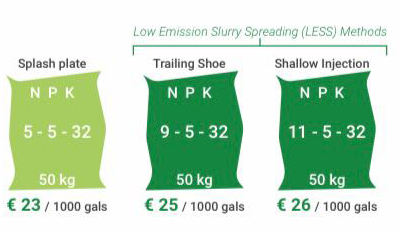
Figure 1. Equivalent N-P-K fertiliser value of 4.5m3 (1.000 gallons) of cattle slurry when applied using splash plate and low emission slurry spreading (LESS) methods.
Reseeding
- Increasing % rye grass in swards increases the uptake and utilisation of applied N.
Fertiliser Planning
- Create a fertiliser plan to target the required nutrients to the appropriate sample results.
- Target nutrients that specifies the rate, timing and product to be applied on each field based on the individual farm systems.

Discover our
NitroFert Fertilisers
For over 25 years, NitroFert has been a leading supplier of fertiliser in Ireland. We manufacture and distribute a complete range of fertilisers to the agricultural industry.
We also provide specific customised blends according to customer requirements. Please contact us with any queries you may have about our products and blends.
 Sign up to our newsletter for the latest news, farming tips and guidance.